
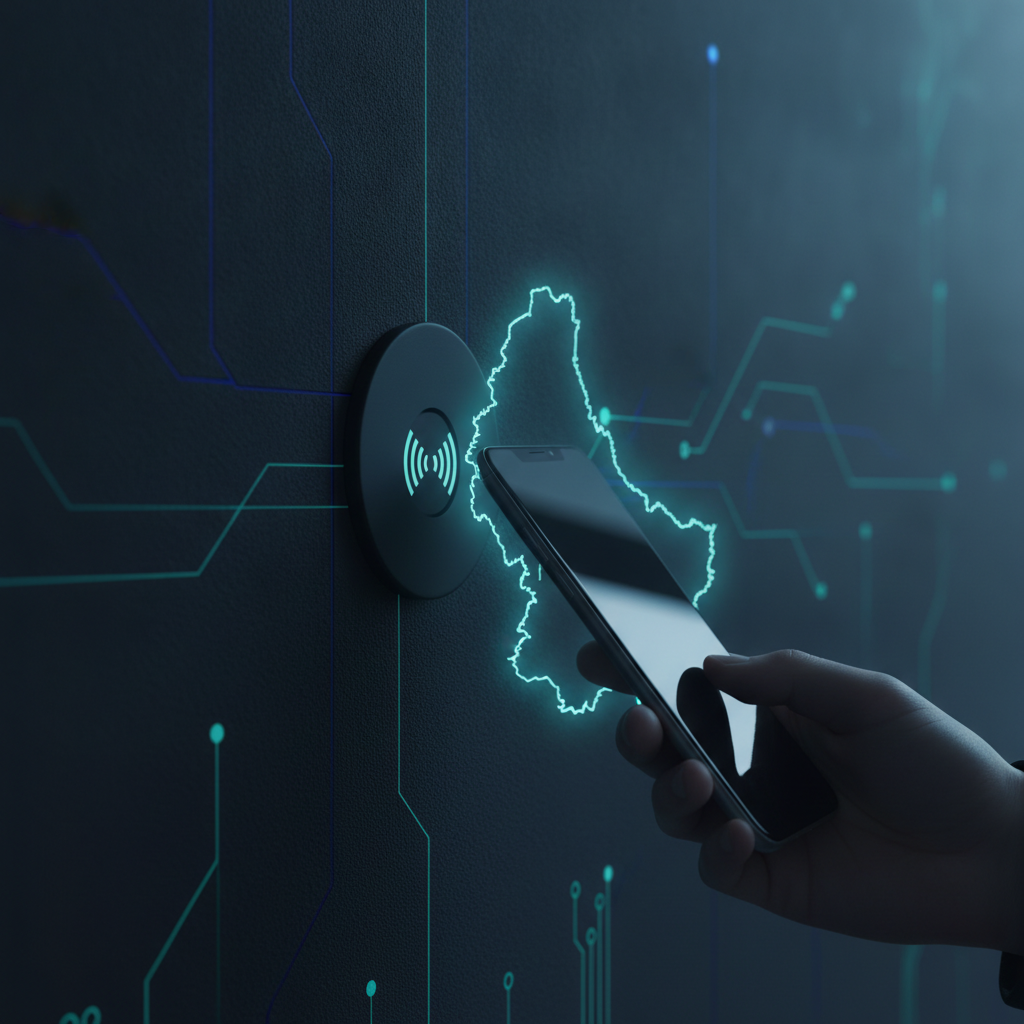
NFC mobile clock-in without GPS answers a simple question: how to prove on-site presence without continuous employee tracking. By combining a signed NFC tag, a zone verification at the exact clock-in moment, and a sealed entry in the time ledger, employers get usable traceability while employees are never tracked in the background. It is a pragmatic way to align HR needs, ITM expectations, and CNPD guidance on data minimisation.
Why aim for clock-in without continuous GPS
For working time in Luxembourg, the labour inspectorate, ITM, expects systems that are reliable, traceable and reviewable. At the same time, the data protection authority, CNPD, issues workplace monitoring guidance that emphasises proportionality and data minimisation. Between these requirements, NFC mobile clock-in without GPS offers a concrete alternative: verify presence at a precise spot at the instant of clock-in, with no continuous geolocation and no background collection.
This model is attractive for four main reasons:
- Social acceptability: no permanent tracking, which reduces friction, especially in BYOD and shift work contexts.
- Operational effectiveness: works in basements, datacentres and shielded workshops where GPS fails.
- Practical precision: the declared zone is controlled by the employer, down to a doorway, shop floor or level.
- Regulatory simplicity: a clear purpose, limited data, a legal basis that is easier to document in a DPIA.
In practice, employers must produce usable evidence during ITM inspections or pay disputes, and feed CCSS payroll processes. Proving that someone was on site at the right time window, when they clocked in, often suffices to support the time ledger and payslips. The key is a robust yet narrow proof.
How signed NFC clock-in works without GPS
The setup uses programmed and signed NFC tags, iOS or Android smartphones, and a clock-in app. No continuous geolocation is enabled. The zone is checked only at the clock-in moment, which limits data collection.
- NFC tag: each site or sub-zone gets a secured NFC tag. It carries a zone identifier and a signed payload that detects cloning and out-of-context reuse.
- Smartphone read: the employee taps, the app reads the tag and builds a clock-in event with trusted timestamp and a zone fingerprint. No background tracking.
- At-the-instant verification: the signature and a short-lived challenge validate that the tag is authentic and not replayed. Expiration policies further reduce fraud surface.
- Sealed evidence: the event is server-signed and recorded in the time ledger. An integrity chain supports later audits.
- Offline: if the network is down, the app queues the event in an encrypted buffer. The proof remains anchored to a secure local timestamp and is consolidated when connectivity returns.
For sensitive areas, the NFC tag can be complemented by a very short-range proximity check without enabling GPS. The goal stays the same: verify presence only at the clock-in instant. In terms of UX, employees review periods and discrepancies in MySafeBox, with secure receipts in their vault, while managers handle exceptions and exports in FXP for multi-client fiduciary dossiers.
Luxembourg compliance: CNPD, ITM, CCSS and regulated sectors
A time tracking setup must be justified, proportionate and documented. CNPD guidance on workplace monitoring stresses the need test, transparency for data subjects, and security measures appropriate to GDPR article 32. NFC mobile clock-in without GPS helps minimisation: you collect a single presence proof at a point in time, nothing more.
- Notice and DPIA: provide a clear notice, state purpose, recipients, legal retention periods, and perform a DPIA when context requires it, to be confirmed with your DPO.
- Working time record: ITM expects a reliable system that enables review of hours and overruns. Timestamped, sealed and verifiable exports support inspections.
- Payroll and CCSS: the ledger feeds payroll, which in turn feeds CCSS declarations. Rounding and allowances must follow your internal scale and applicable collective agreement.
- Allowances and reimbursements: for certain benefits, the ACD and, where applicable, the RTS office expect consistent supporting documents. Zone-based presence proof can contribute, subject to internal policy.
- Regulated sectors: under CSSF or CAA oversight, outsourcing and hosting require risk analysis, provider governance and adequate contractual clauses. Documenting sub-processor control and Luxembourg hosting location is key.
On security, encryption in transit and at rest, environment segregation, role-based access control and integrity logging align with CNPD expectations. Plan for data subject rights procedures, evidence retention per your policy, and the ability to extract a complete case file in disputes.
BYOD, personal phone refusal: practical alternatives
BYOD is divisive. Some employees will rightly refuse to use their personal phone for work. The NFC model is more acceptable than GPS tracking, but it does not solve everything. Concrete alternatives must be planned, documented in internal policy and discussed with staff representation where applicable.
- Company smartphone: provide a dedicated device to field teams, with the clock-in app and light MDM.
- Company NFC badge: pair the zone tag with a badge or access card, read by a shared tablet at entry, with no personal app.
- Clock-in kiosk: deploy a kiosk tablet near sensitive areas. The user taps the tag, authenticates, and the event is sealed.
- Supervised QR: for temporary sites, a dynamic signed QR can play the same role, with a zone check at scan time, no continuous GPS.
For confidentiality, MySafeBox provides a per-employee encrypted vault for payslips, time extracts and sensitive exchanges without email. Fiduciaries operating across clients can orchestrate leave, exceptions and exports in FXP while keeping dossier-specific workflows. If you onboard agents or contractors, automated due diligence is covered by Luxapps KYC, with an AML/CFT-compliant journey for obliged professionals.
Architecture, security, hosting in Luxembourg
For audit-grade evidence, architecture matters. Hosting in Luxembourg with LuxOps addresses location requirements for many employers. Application and operational security are handled by Luxgap, and continuous technical checks are tracked via devops.luxgap.com. This is not a marketing claim, it is an operating model with logging, hardening, and regular code and infrastructure review.
- Tags and keys: NFC tag inventory, dedicated key management and planned rotation prevent cloning and keep the proof strong.
- Integrity: each event is sealed, timestamped and chained. Audit exports include integrity metrics and details of workstation, zone and user.
- Confidentiality: encryption in transit and at rest, role-based access control, per-client separation, especially in FXP for multi-client fiduciaries.
- Privacy by design: no continuous geolocation, no opportunistic collection, employee visibility on their own data in MySafeBox.
- Reversibility: full export of ledgers and settings, open formats, documentation and exit procedures to avoid lock-in.
Beyond technology, organisation matters: access logs, incident handling, periodic reviews with the DPO, and contractual clauses that define sub-processors, responsibilities and security measures. These elements together reassure HR, finance, compliance and IT during CNPD oversight or ITM inspections.
Procurement checklist and next steps
Before deciding, frame your choice around a short, measurable pilot. Target one site, one workshop, one mobile crew. Write a clear internal policy, inform employees and collect feedback.
- Use cases: simple entries, multiple zones, night shifts, temporary sites, no-network locations.
- Acceptability: BYOD, no-personal-phone alternatives, kiosks and badges.
- Evidence: signature strength, replay resistance, integrity audit, readable export for ITM and payroll-ready proof.
- Compliance: notice, DPIA if needed, retention, access rights, incident playbook, Luxembourg hosting location.
- Interoperability: payroll integration, CCSS, exports, APIs, reversibility.
- Costs: clear TCO, tag lifecycle, devices, support, training.
To help you visualise, we built a small demonstrator with AI Studio called “PulseTag Verifier”. It simulates reading a signed NFC tag, short-lived expiration, and creating a sealed proof without turning on geolocation. It is not a client product, but a useful testbed to discuss process and security with your teams.
Ready to assess a clock-in that is verified at the instant only. We design and integrate compliant time ledgers in FXP, MySafeBox or custom builds, with Luxembourg hosting and structured operational security. Talk to our team and schedule a pilot. Explore our approach to time tracking in Luxembourg or contact us via our contact page.